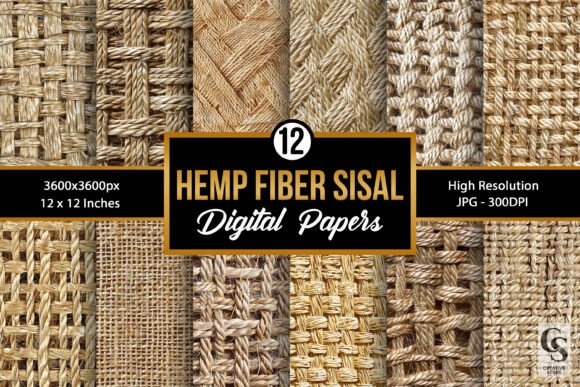
Hemp Fiber Sisal Texture Backgrounds: Earthy Digital Papers
There is a distinct kind of visual grounding that comes from natural materials. In a digital landscape often saturated with high-gloss, hyper-polished vector art, the raw, tactile quality of organic fibers offers a necessary pause. This collection of Hemp Fiber Sisal Texture Backgrounds captures that specific, earthy aesthetic, providing designers with a versatile set of assets that bridge the gap between digital creation and physical reality. When you open the zip file containing the 12 seamless patterns, you aren't just getting images; you are accessing a library of warmth, durability, and authenticity that can elevate a project from merely functional to deeply resonant.
The Visual Personality of Natural Fibers
Understanding the visual weight of these textures is key to using them effectively. Sisal and hemp are not smooth, uniform surfaces. They are characterized by a complex weave, slight irregularities, and a matte finish that absorbs light rather than reflecting it. The visual "personality" of these Hemp Fiber Sisal Texture Backgrounds is one of honesty and sturdiness. The color palette typically leans toward neutral beiges, warm tans, and soft creams, though the variations in the weave create subtle shadows and depth that make the background dynamic without being distracting.
For a designer, this texture communicates reliability. Unlike a generic digital gradient, a sisal texture implies craftsmanship. It suggests that the content layered on top of it—whether that is typography, photography, or illustration—has substance. This is particularly valuable in an era where consumers are increasingly drawn to brands that feel "human" and grounded. The texture does the heavy lifting of setting a mood; it instantly signals a connection to nature, sustainability, or handmade quality, depending on the context in which it is placed.
Strategic Applications for Modern Creators
The utility of the Hemp Fiber Sisal Texture Backgrounds extends far beyond simple decoration. In brand identity and packaging design, these textures serve as a foundation for products that aim to feel premium yet approachable. Imagine a coffee roaster’s label or a skincare brand’s packaging; the inclusion of a fiber texture instantly elevates the perception of the product, suggesting raw ingredients and careful formulation. It is a subtle form of visual storytelling that aligns the product with nature before the customer even reads the copy.
In the realm of editorial design and web design, these textures solve the common problem of "flat" layouts. Modern minimalism often risks looking sterile. By utilizing these seamless patterns as page backgrounds or section dividers, you introduce warmth and dimension. The texture acts as a visual anchor, allowing sans-serif fonts to pop with greater clarity. For social media graphics, where the goal is to stop the scroll, a textured background provides a tactile contrast to the smooth glass of a smartphone screen. It draws the eye because it feels different from the standard digital noise.
Technical Excellence for Print and Digital
One of the most critical aspects of working with texture files is resolution. Low-resolution textures can pixelate and blur, ruining the illusion of realism. This collection addresses that concern head-on with High-Resolution 300dpi files sized at 3600 x 3600 pixels. This specification is non-negotiable for professional print work. Whether you are designing greeting cards, invitations, or planners, the 12-inch square format ensures that the weave remains crisp and detailed even when printed at full bleed.
The seamless nature of the patterns is equally important for Digital Papers. In scrapbook decorations or DIY projects, you often need to tile a texture to fill a large space or create a border. Because these files are seamless, the edges disappear when tiled, creating a continuous, unbroken surface. This technical precision allows for flexibility in logo design as well; you can use the texture as a clipping mask within text or shapes, ensuring the organic look scales perfectly with your vector elements.
Integrating Texture into Your Design Workflow
Using Hemp Fiber Sisal Texture Backgrounds effectively requires a thoughtful approach to layering. These assets work best as a supporting element rather than the protagonist. If you are creating a tumbler wrap or notebook cover, consider how the opacity of the texture interacts with your foreground elements. A slight reduction in opacity can soften the texture, making it a subtle backdrop, while keeping it at 100% preserves the raw, tactile feel.
When pairing fonts with these backgrounds, contrast is your friend. The organic, irregular nature of the sisal weave pairs exceptionally well with clean, geometric sans-serif fonts. The sharpness of the typeface cuts through the softness of the fiber, ensuring high readability. Conversely, for a more rustic or vintage aesthetic, pairing the texture with a serif font or a handwritten font can create a cohesive, "lived-in" feel that is perfect for wedding invitations or artisanal branding.
Practical Guidance for Selection and Licensing
When evaluating these assets for your specific needs, consider the scale of the weave in relation to your final output size. For stationery and wall art, a tighter weave often works better to maintain detail at a distance. For wallpapers or large-scale prints, the larger fiber variations can add significant drama and texture.
Furthermore, understanding the versatility of the 12 included Digital Papers allows you to experiment. Don't feel locked into using the texture only as a background. Use it to fill typography for a "cut-out" effect, or apply it to specific shapes within a composition to create depth. Because these files are JPGs, they are compatible with virtually every design software on the market, from Adobe Photoshop and Illustrator to Canva and Procreate.
Ultimately, the value of the Hemp Fiber Sisal Texture Backgrounds lies in their ability to add instant character. In a world of flat design, adding a layer of realism can be the differentiator that makes your work memorable. Whether you are a content creator looking to spice up your feed, a small business owner designing your own packaging, or a hobbyist creating personalized gifts, these textures provide a professional-grade foundation that is both visually appealing and technically sound. They are not just images; they are tools for building a more authentic visual narrative.